`` How do I take Acthar® Gel (repository corticotropin injection)?

There are different ways to take Acthar Gel

Acthar Gel is available in 2 administration options: the Acthar Single-Dose Pre-filled SelfJect™ Injector or the multi-dose vial and syringe.

John, treated with Acthar Gel.
Individual results may vary. Compensated by Keenova.

Talk with your doctor about a method that works for you

Learn the proper ways to inject Acthar Gel with easy step-by-step instructions, a training video, and downloadable resources.
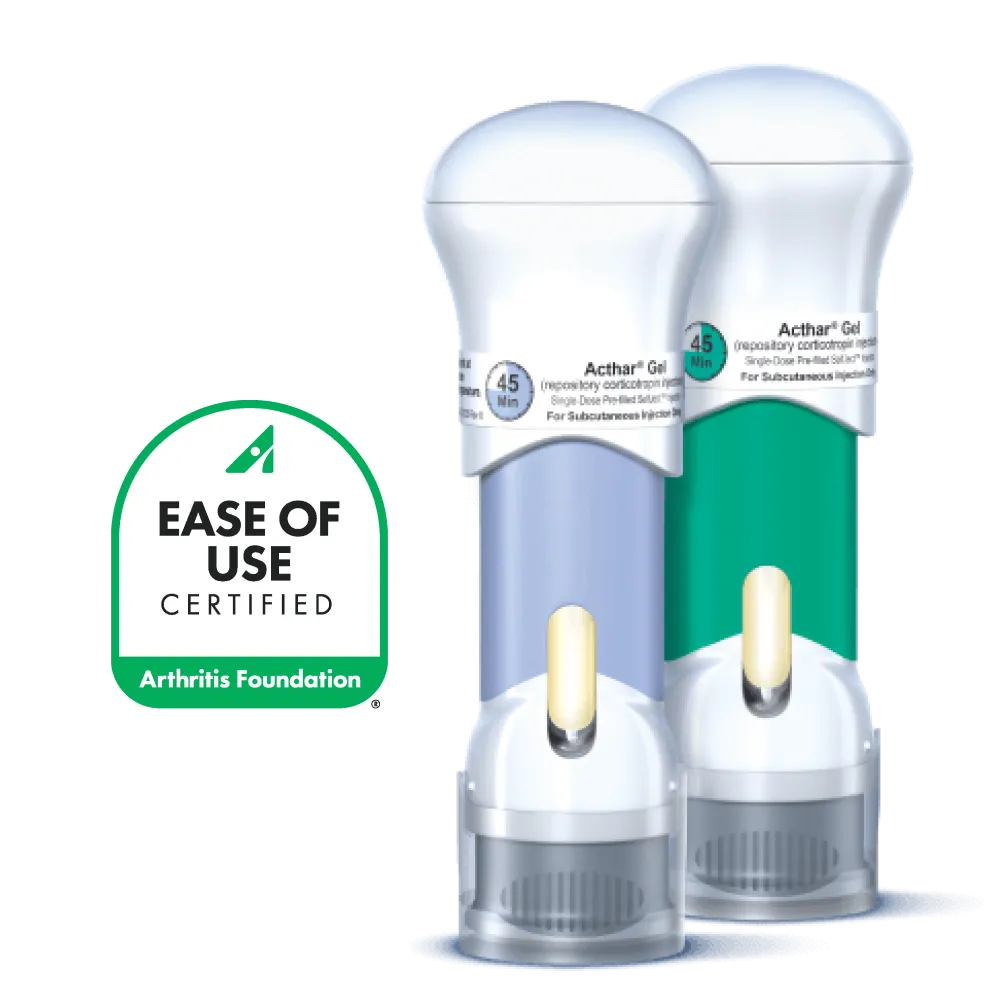
Acthar Gel SelfJect

Designed with your needs in mind

  • All-in-one injection device is pre-filled with the dose your doctor prescribed
  • Designed to give you the correct dose by pressing down on the handle
  • Easy-to-hold design that may help people with grip and vision issues
  • Requires fewer steps compared to administration with vial and syringe
If you have questions about using SelfJect, talk with your doctor or care team. You can also watch our step-by-step video.

SelfJect is for under-the-skin (subcutaneous) use only for people prescribed 40 units (green body) or 80 units (purple body) of Acthar Gel. SelfJect should only be given by adults who are 18 years of age or older. If you are under age 18, an adult must do the SelfJect injection for you.

If your dose is different than 40 or 80 units, the vial and syringe method may be right for you.

Devices are not shown at actual size. The exterior configuration of the drug delivery device is owned by West Pharmaceutical Services, Inc. and is used with permission.

Before using SelfJect

  • Store SelfJect in the refrigerator

    Refrigerate your SelfJect injectors as soon as you get them. The refrigerator temperature should be set between 36 °F and 46 °F (2 °C and 8 °C).

  • Leave each injector in its plastic tray

    This helps protect it from light and damage.

  • Check the expiration date

    Use the injector before the expiration date, located on the label on the tray.
    Do not use if SelfJect is expired.

  • Let the injector reach room temperature

    Before using, the injector needs to sit at room temperature (68 to 77 °F, or 20 to 25 °C) for at least 45 minutes to warm to room temperature. It can stay at room temperature for up to 24 hours.

  • Look at the medicine

    Before each use, look through the window on the injector. Do not use it if you see any signs of contamination (cloudiness, small flecks in the medicine).

    If your medicine is expired or contaminated, call Acthar Patient Support at 888-435-2284.

How to use SelfJect

Watch a step-by-step video to learn how to prepare and take Acthar Gel safely. You can also explore helpful resources in Spanish.

Read the Acthar Gel Instructions for Use

Be sure to read the Instructions for Use for your prescribed dose (40 units or 80 units) to learn how to properly use your injector.

Injection Placement Injection placemat

Get step-by-step instructions for using SelfJect, plus a place to put your treatment supplies while injecting.

Magnifying Glass Treatment journal

Log your treatment schedule, track appointments, and store contact information for your care team.

Recycle Icon
Sustainable disposal for your used SelfJect devices

Keenova is committed to reducing the environmental impact of used SelfJect injectors. That's why we offer a free, sustainable disposal program for patients using Acthar Gel. You can join the program at any time—at no cost to you.

Contact your Case Manager for more information at 1-888-435-2284

Monday – Friday, 8 AM to 9 PM ET
Saturday, 9 AM to 2 PM ET
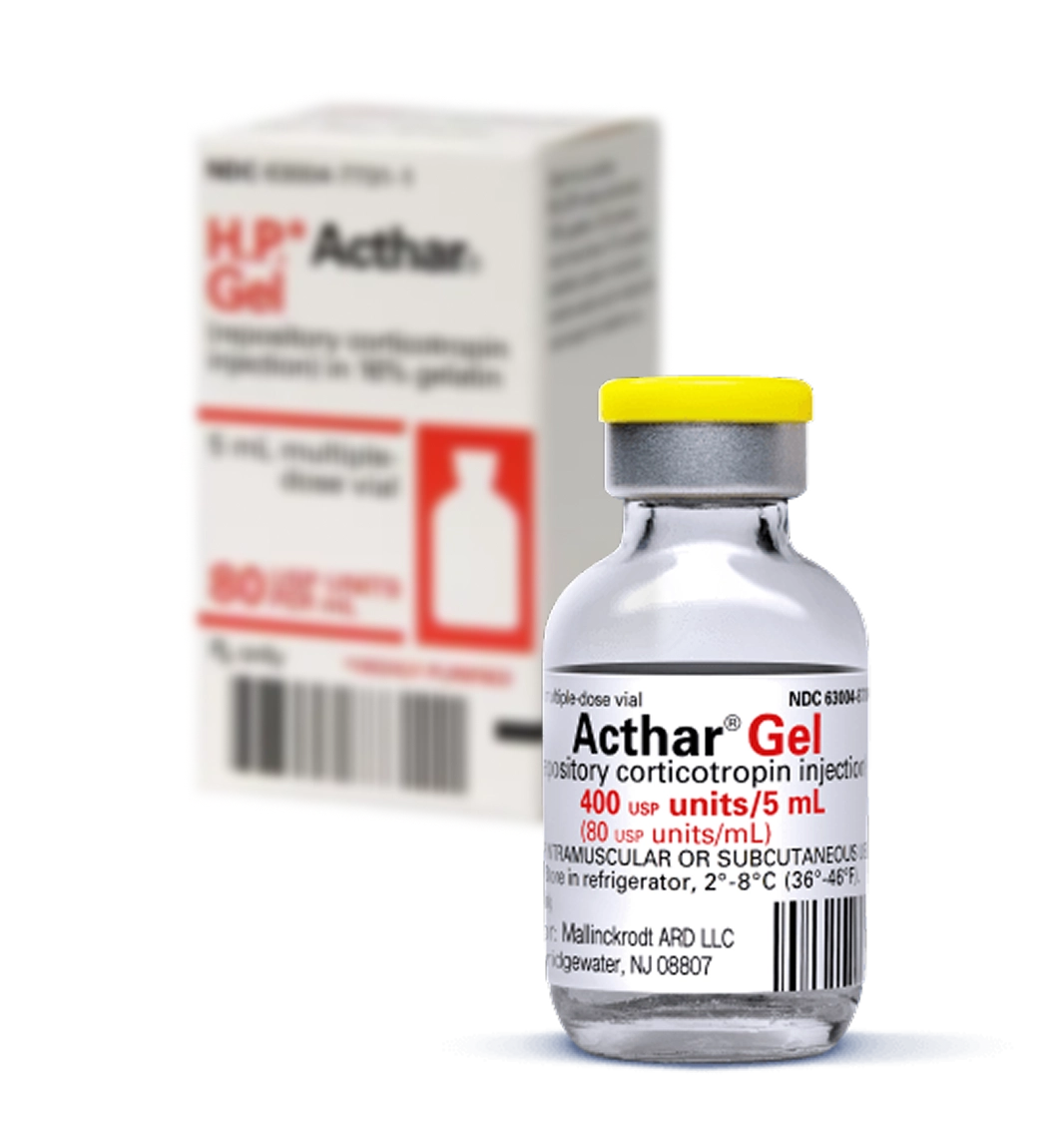
Acthar Gel Vial

Getting your Acthar Gel dose ready

Acthar Gel can be taken under the skin (subcutaneously) or into a muscle (intramuscularly) using a vial and syringe. Your doctor will tell you which way is best for you.

Before you inject Acthar Gel

  • Check the vial to make sure that the label states it is Acthar Gel.

  • Check the expiration date on the Acthar Gel vial to make sure you are using it before the date listed.

  • Refrigerate Acthar Gel as soon as you receive it and check that your refrigerator temperature is currently 36-46 °F or 2-8 °C.

    • Unopened vials that are refrigerated (36-46 °F or 2-8 °C) are good until the last day of the month listed for expiration on the vial
    • For example, if your vial's expiration date is 7/2026, it should be discarded on 7/31/2026
  • Prior to each use, check for any signs of contamination (cloudiness, small flecks in the medicine).

    DO NOT USE IF:

    • The vial is expired
    • Any signs of contamination are seen

    If your medicine is expired or contaminated, call Acthar Patient Support at 888-435-2284.

    Read the entire instruction guide before you begin your first injection and as needed prior to any injection.

  • After a vial has been opened (the top seal has been punctured by a needle), it should be discarded after 28 days. For example, if the date you opened a vial was 7/1/2026, you would need to dispose of that vial by 7/29/2026.

If you have questions about using Acthar Gel, talk with your doctor or care team. You can also watch our step-by-step video.

Dose conversion

This chart can help you remember how much medicine to draw up into the syringe.

Prescribed unitsInjection amount
80 units1.0 mL injection
60 units0.75 mL injection
40 units0.5 mL injection
20 units0.25 mL injection

The values shown are not all the possible dosages of Acthar Gel. Dosage and frequency may vary. Your doctor has determined the best dose for you based on your medical history and condition.

Acthar Gel injection training video

Watch a step-by-step video on how to prepare and take Acthar Gel or choose a specific chapter from the video list. You can also view this resource in Spanish.

If you are treating your baby for infantile spasms, see instructions on giving Acthar Gel.

SELECT CHAPTER

  • Play Icon
    1.  Welcome to Acthar Gel
  • Play Icon
    2.  Injecting Acthar Gel: Introduction
  • Play Icon
    3.  Getting started with Acthar Gel
  • Play Icon
    4.  Preparing to inject
  • Play Icon
    5.  Where to inject subcutaneously
  • Play Icon
    6.  Subcutaneous injection instructions
  • Play Icon
    7.  Post-injection instructions
  • Play Icon
    8.  About Acthar Patient Support
  • Play Icon
    9.  Indications and Important Safety Information
  • Play Icon
    10.  Where to inject intramuscularly
  • Play Icon
    11.  Intramuscular injection instructions
Injection Placement Injection Training Guide

Download a guide that helps walk you through the steps of the injection process.

Magnifying Glass Treatment journal

Log your treatment schedule, track appointments, and store contact information for your care team.

UP NEXT:
Need injection help? Personalized training can help you feel more prepared
What is Acthar Gel?
Toggle ISI tray

Acthar Gel is a prescription medicine used for:

  • Treatment for flares or on a regular basis (maintenance) in people with dermatomyositis or polymyositis (DM-PM)
  • Treatment for flares or on a regular basis (maintenance) in people with systemic lupus erythematosus (lupus)
  • Add-on therapy for short-term administration (to tide patients over an acute episode or exacerbation) in: psoriatic arthritis (PsA); rheumatoid arthritis (RA), including juvenile rheumatoid arthritis (selected cases may require low-dose maintenance therapy); ankylosing spondylitis
  • Treatment for people with symptomatic sarcoidosis
  • Treatment of severe acute and chronic allergic and inflammatory conditions affecting different parts of the eye. This can include the front part of the eye such as the cornea and iris, or the back part of the eye such as the optic nerve and retina
  • Reduction of proteinuria in people with nephrotic syndrome of the idiopathic type (unknown origin) without uremia (accumulation of urea in the blood due to malfunctioning kidneys) or that due to lupus erythematosus (lupus)
  • Treatment for adults with acute relapses or flares of multiple sclerosis (MS). Studies have shown Acthar to be effective in speeding recovery from an MS relapse. However, there is no evidence that it affects the ultimate outcome or natural history of the disease
  • Treatment of infantile spasms in infants and children under 2 years of age

Acthar is injected beneath the skin or into the muscle.

IMPORTANT SAFETY INFORMATION
Toggle ISI tray

DO NOT take Acthar until you have talked to your doctor if you have any of the following conditions:

  • Have been given or are about to receive a live or live attenuated vaccine
  • A skin condition called scleroderma
  • Bone density loss or osteoporosis
  • Any infections, including fungal, bacterial, or viral
  • Eye infections, such as ocular herpes simplex
  • Had recent surgery
  • Stomach ulcers or a history of stomach ulcers
  • Heart failure
  • Uncontrolled high blood pressure
  • Addison's disease or Cushing's syndrome
  • Allergies to pig-derived proteins
  • Suspected infections at birth (in infants under 2 years of age)

Tell your doctor about any other health problems that you have. Give your doctor a complete list of medicines you are taking, including all prescription and nonprescription medicines, vitamins, and herbal supplements.

What is the most important information I should know about Acthar?

  • Never inject Acthar directly into a vein
  • Acthar is injected beneath the skin or into the muscle. Always inject Acthar with SelfJect beneath the skin
  • Follow your doctor's instructions for injecting Acthar
  • Never stop treatment suddenly unless your doctor tells you to do so
  • Try not to miss any scheduled doctor's appointments. It is important for the doctor to monitor you while taking Acthar
  • You may be more likely to get new infections. Also, old infections may become active. Tell your doctor if you see any signs of an infection. Contact your doctor at the first sign of an infection or fever.
    Signs of infection are: fever, cough, vomiting, or diarrhea. Other signs may be flu or any open cuts or sores
  • When taking Acthar long-term, your adrenal gland may produce too much of a hormone called cortisol. This can result in symptoms of Cushing's syndrome. This may cause increased upper body fat, a rounded “moon” face, bruising easily, or muscle weakness
  • Sometimes when you stop taking Acthar long-term, your body may not produce enough natural cortisol. This is called "adrenal insufficiency." Your doctor may prescribe a steroid medicine to protect you until the adrenal gland recovers
  • You might develop high blood pressure, retain too much salt and water, or have low blood potassium levels. As a result of this, your doctor may recommend some changes to your diet, such as eating less salt or taking certain supplements
  • Vaccines may not work well when you are on Acthar. Talk to your doctor about which vaccines are safe to use while you are taking Acthar
  • Acthar may hide symptoms of other diseases. This can make it more difficult for your doctor to make a diagnosis of something else is going on
  • Stomach or intestinal problems. Acthar may increase the risk of bleeding and stomach ulcers. Tell your doctor if you have stomach pains, bloody vomit, bloody or black stools, excessive tiredness, increased thirst, difficulty breathing, or increased heart rate
  • Taking Acthar can make you feel irritable or depressed. You may also have mood swings or trouble sleeping. These effects are reversible once Acthar therapy is stopped
  • If you have other conditions, such as diabetes or muscle weakness, you may find they get worse
  • You might develop certain eye conditions, such as cataracts, glaucoma, or optic nerve damage
  • Your body may develop allergies to Acthar; these allergies may be severe. Signs of allergic reaction include:
    • Skin rash and itching
    • Swelling of the face, tongue, lips, or throat
    • Trouble breathing
  • The effects of Acthar may be intensified if you have an underactive thyroid or cirrhosis of the liver
  • Long-term Acthar use can affect growth and physical development in children. This can be reversed when Acthar is no longer needed
  • Acthar may cause osteoporosis (weak bones)
  • Acthar might harm an unborn baby. Therefore, tell your doctor if you are pregnant or plan to become pregnant

What are the most common side effects of Acthar?

Commonly reported side effects of Acthar include:

  • Injection site reaction
  • Fatigue, physical weakness, and lack of energy
  • Fluid retention
  • Insomnia (difficulty sleeping)
  • Headache
  • High blood sugar

The most common side effects for the treatment of infantile spasms (IS) are:

  • Increased risk of infections
  • Convulsions
  • High blood pressure
  • Irritability
  • Fever

The above side effects may also be seen in adults and children over 2 years of age. Some children with IS progress to other forms of seizures. IS sometimes makes these seizures, which may become visible after treatment for IS has been completed.

These are not all of the possible side effects of Acthar.

Tell your doctor about any side effect that bothers you, or that does not go away. Call your doctor or pharmacist for medical advice about side effects. You may report side effects to the FDA. Call 1-800-FDA-1088 or visit www.fda.gov/medwatch . You may also report side effects by calling 1-800-844-2830.

Please see the full Prescribing Information. If you've been prescribed SelfJect, please see the 40-unit or 80-unit Instructions for Use and the 40-unit or 80-unit Quick Reference Guide.

For parents and caregivers of children with infantile spasms, please also see Medication Guide.

Toggle ISI tray

What is Acthar Gel?

Acthar Gel is a prescription medicine used for:

  • Treatment for flares or on a regular basis (maintenance) in people with dermatomyositis or polymyositis (DM-PM)
  • Treatment for flares or on a regular basis (maintenance) in people with systemic lupus erythematosus (lupus)
  • Add-on therapy for short-term administration (to tide patients over an acute episode or exacerbation) in: psoriatic arthritis (PsA); rheumatoid arthritis (RA), including juvenile rheumatoid arthritis (selected cases may require low-dose maintenance therapy); ankylosing spondylitis
  • Treatment for people with symptomatic sarcoidosis
  • Treatment of severe acute and chronic allergic and inflammatory conditions affecting different parts of the eye. This can include the front part of the eye such as the cornea and iris, or the back part of the eye such as the optic nerve and retina
  • Reduction of proteinuria in people with nephrotic syndrome of the idiopathic type (unknown origin) without uremia (accumulation of urea in the blood due to malfunctioning kidneys) or that due to lupus erythematosus (lupus)
  • Treatment for adults with acute relapses or flares of multiple sclerosis (MS). Studies have shown Acthar to be effective in speeding recovery from an MS relapse. However, there is no evidence that it affects the ultimate outcome or natural history of the disease
  • Treatment of infantile spasms in infants and children under 2 years of age

Acthar is injected beneath the skin or into the muscle.

IMPORTANT SAFETY INFORMATION

DO NOT take Acthar until you have talked to your doctor if you have any of the following conditions:

  • Have been given or are about to receive a live or live attenuated vaccine
  • A skin condition called scleroderma
  • Bone density loss or osteoporosis
  • Any infections, including fungal, bacterial, or viral
  • Eye infections, such as ocular herpes simplex
  • Had recent surgery
  • Stomach ulcers or a history of stomach ulcers
  • Heart failure
  • Uncontrolled high blood pressure
  • Addison's disease or Cushing's syndrome
  • Allergies to pig-derived proteins
  • Suspected infections at birth (in infants under 2 years of age)

Tell your doctor about any other health problems that you have. Give your doctor a complete list of medicines you are taking, including all prescription and nonprescription medicines, vitamins, and herbal supplements.

What is the most important information I should know about Acthar?

  • Never inject Acthar directly into a vein
  • Acthar is injected beneath the skin or into the muscle. Always inject Acthar with SelfJect beneath the skin
  • Follow your doctor's instructions for injecting Acthar
  • Never stop treatment suddenly unless your doctor tells you to do so
  • Try not to miss any scheduled doctor's appointments. It is important for the doctor to monitor you while taking Acthar
  • You may be more likely to get new infections. Also, old infections may become active. Tell your doctor if you see any signs of an infection. Contact your doctor at the first sign of an infection or fever.
    Signs of infection are: fever, cough, vomiting, or diarrhea. Other signs may be flu or any open cuts or sores
  • When taking Acthar long-term, your adrenal gland may produce too much of a hormone called cortisol. This can result in symptoms of Cushing's syndrome. This may cause increased upper body fat, a rounded “moon” face, bruising easily, or muscle weakness
  • Sometimes when you stop taking Acthar long-term, your body may not produce enough natural cortisol. This is called "adrenal insufficiency." Your doctor may prescribe a steroid medicine to protect you until the adrenal gland recovers
  • You might develop high blood pressure, retain too much salt and water, or have low blood potassium levels. As a result of this, your doctor may recommend some changes to your diet, such as eating less salt or taking certain supplements
  • Vaccines may not work well when you are on Acthar. Talk to your doctor about which vaccines are safe to use while you are taking Acthar
  • Acthar may hide symptoms of other diseases. This can make it more difficult for your doctor to make a diagnosis of something else is going on
  • Stomach or intestinal problems. Acthar may increase the risk of bleeding and stomach ulcers. Tell your doctor if you have stomach pains, bloody vomit, bloody or black stools, excessive tiredness, increased thirst, difficulty breathing, or increased heart rate
  • Taking Acthar can make you feel irritable or depressed. You may also have mood swings or trouble sleeping. These effects are reversible once Acthar therapy is stopped
  • If you have other conditions, such as diabetes or muscle weakness, you may find they get worse
  • You might develop certain eye conditions, such as cataracts, glaucoma, or optic nerve damage
  • Your body may develop allergies to Acthar; these allergies may be severe. Signs of allergic reaction include:
    • Skin rash and itching
    • Swelling of the face, tongue, lips, or throat
    • Trouble breathing
  • The effects of Acthar may be intensified if you have an underactive thyroid or cirrhosis of the liver
  • Long-term Acthar use can affect growth and physical development in children. This can be reversed when Acthar is no longer needed
  • Acthar may cause osteoporosis (weak bones)
  • Acthar might harm an unborn baby. Therefore, tell your doctor if you are pregnant or plan to become pregnant

What are the most common side effects of Acthar?

Commonly reported side effects of Acthar include:

  • Injection site reaction
  • Fatigue, physical weakness, and lack of energy
  • Fluid retention
  • Insomnia (difficulty sleeping)
  • Headache
  • High blood sugar

The most common side effects for the treatment of infantile spasms (IS) are:

  • Increased risk of infections
  • Convulsions
  • High blood pressure
  • Irritability
  • Fever

The above side effects may also be seen in adults and children over 2 years of age. Some children with IS progress to other forms of seizures. IS sometimes makes these seizures, which may become visible after treatment for IS has been completed.

These are not all of the possible side effects of Acthar.

Tell your doctor about any side effect that bothers you, or that does not go away. Call your doctor or pharmacist for medical advice about side effects. You may report side effects to the FDA. Call 1-800-FDA-1088 or visit www.fda.gov/medwatch. You may also report side effects by calling 1-800-844-2830.

Please see the full Prescribing Information. If you've been prescribed SelfJect, please see the 40-unit or 80-unit Instructions for Use and the 40-unit or 80-unit Quick Reference Guide.

For parents and caregivers of children with infantile spasms, please also see Medication Guide.

close icon
close icon

Are you part of a US healthcare practice?